
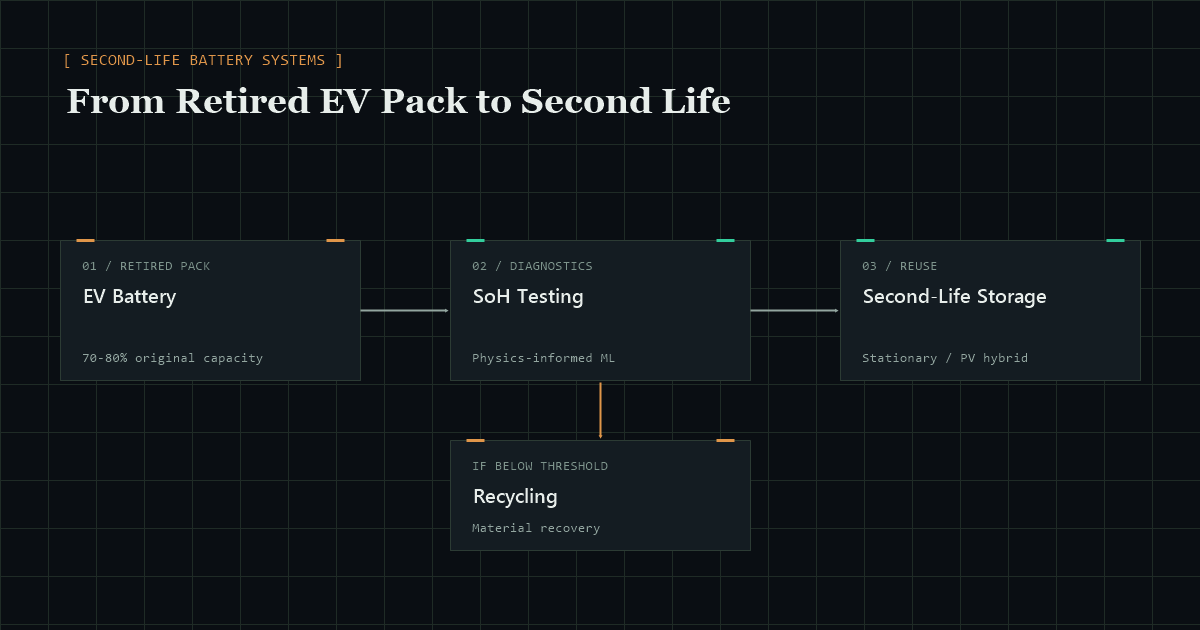
An EV battery pack that’s “worn out” for driving usually still has 70-80% of its original capacity left. That’s not garbage — it’s a perfectly usable stationary battery, just not good enough anymore for the range and power demands of a moving vehicle. The bottleneck isn’t the hardware, it’s not knowing, cheaply and reliably, exactly how much life is actually left and where that pack should go next. That’s the problem my second-life battery research is aimed at.
Why second-life reuse matters
Retiring a battery from vehicle use and sending it straight to recycling throws away most of its remaining value — recycling recovers materials, but a second-life deployment gets years of additional use out of the same cell chemistry first. The catch is that “70-80% capacity” is an average, not a guarantee: real packs degrade unevenly depending on how they were used, and putting a genuinely weak pack into a storage system you’re relying on is worse than not reusing it at all. So the whole second-life pathway lives or dies on accurate, trustworthy state-of-health (SoH) estimation.
Estimating health without a full charge-discharge history
The honest problem with SoH estimation research is that most of it assumes you have dense, complete cycling data for every cell — which real-world retired packs almost never come with. Physics-Informed and Explainable Machine Learning for State-of-Health Estimation of Second-Life Lithium-Ion Batteries Under Sparse Cycling is built around the opposite assumption: sparse, incomplete cycling records, which is what you’ll actually have when a pack arrives from an unknown vehicle history.
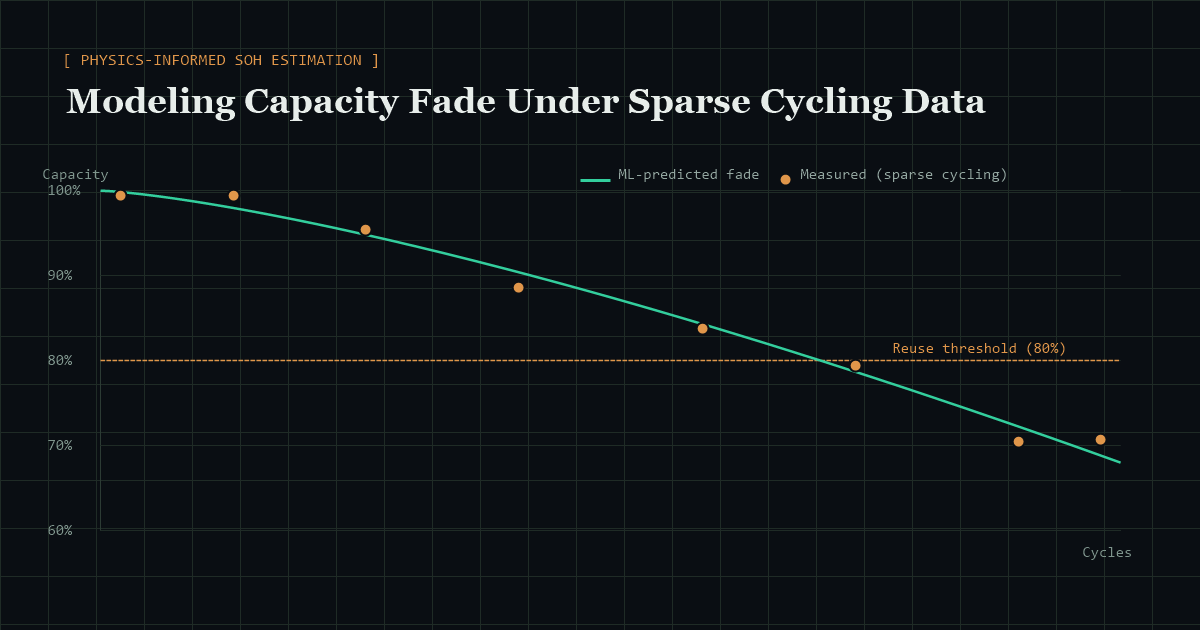
Two things matter beyond raw accuracy here. First, “physics-informed” means the model is constrained by actual degradation mechanisms rather than free to fit any curve that matches the training points — that’s what keeps predictions sane when the input data is thin. Second, explainability isn’t a nice-to-have: if a model tells an operator “this pack is below the reuse threshold,” they need to know why, not just trust a black-box number, especially when the decision affects a capital purchase.
From health estimate to reuse decision
A single SoH percentage is a start, not a decision. Experimental Multi-Metric Health Assessment of Second-Life Electric Vehicle Batteries for Reuse Pathway Classification looks at combining multiple health indicators — not just remaining capacity, but internal resistance and other degradation signals together — to actually classify which reuse pathway a pack is suited for, rather than a single pass/fail cutoff. Some packs are fine for a low-cycling stationary application even if they wouldn’t hold up to daily deep cycling.
Where the batteries actually go: solar-hybrid charging
The most concrete deployment case I’ve studied is pairing second-life battery storage with solar PV for EV charging stations — the battery buffers solar generation against charging demand instead of relying purely on the grid. Techno-Economic and Environmental Evaluation of Second-Life Battery PV Hybrid Charging Stations for Sustainable E-Mobility in Tropical Regions covers both the economics and the environmental case for this specifically in a tropical climate, where solar generation patterns and cooling demands differ a lot from the temperate-climate studies most of this literature is based on.
The bigger picture
None of this works as a one-off lab result — it has to hold up as a repeatable pipeline: test a pack cheaply, estimate its health honestly (including admitting uncertainty), classify it into the right reuse pathway, and only recycle what’s actually not worth reusing. That pipeline is what ties these papers together, and it’s the part of the EV supply chain I think is still the most underbuilt.
Full technical details are in my publications — happy to talk to anyone working on battery reuse, recycling economics, or stationary storage deployment: get in touch.